Candle Fragrance Oil Percentage Guide:
6% vs. 8% vs. 10% Scent Throw Matrix
Published on August 26, 2026 • By MakerRatio Candle Lab • Calibrated on Digital Gram Scales
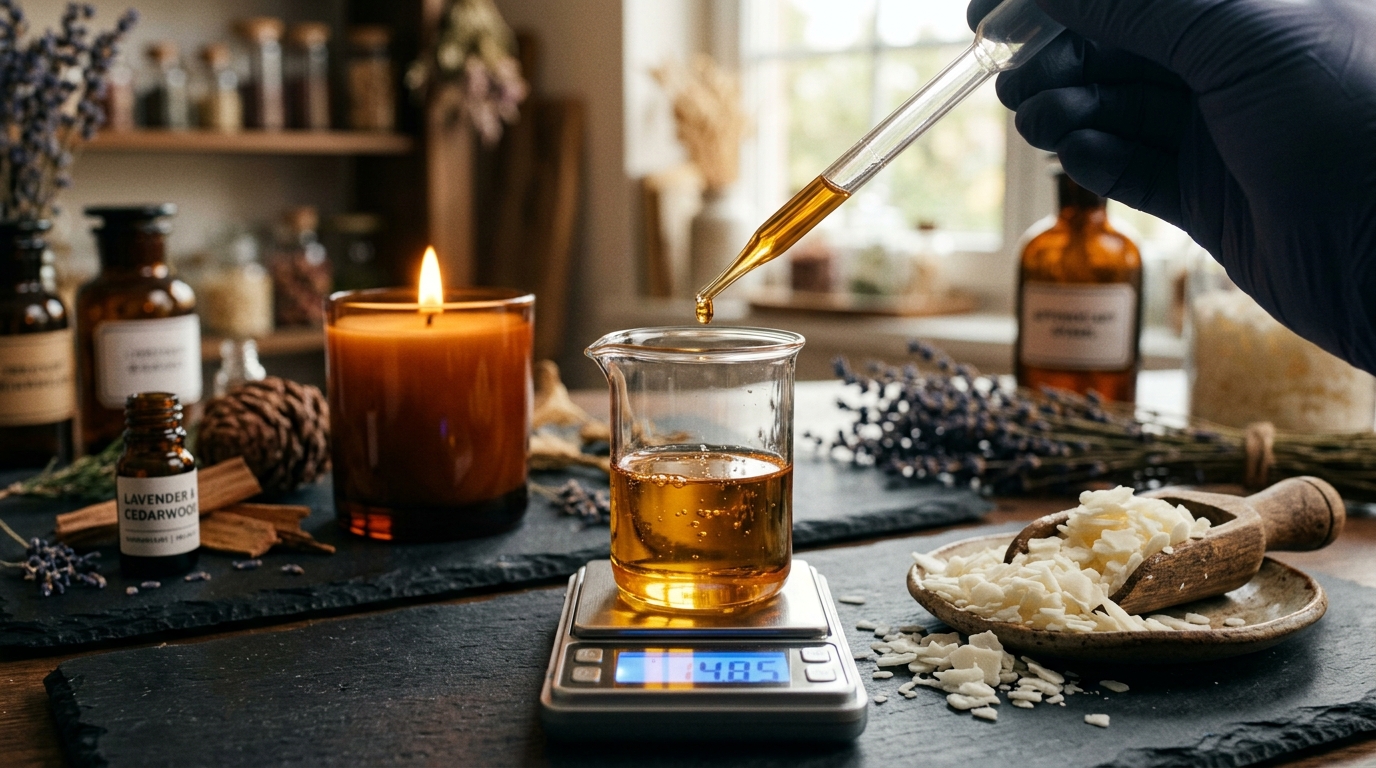
Studio Formulation: Measuring fragrance oil load by weight on a 0.01g digital scale with pure soy wax flakes.
What fragrance oil percentage should you use in soy candles? The industry standard for natural soy wax (such as Golden Brands 464) is 8% to 10% fragrance load by weight. An 8% load (approximately 0.8 oz / 24g of oil per 300g of wax) provides the optimal balance of strong hot scent throw without oil sweating or wick clogging. Never exceed 10% in pure soy wax; overloading past the wax's saturation point causes fragrance oils to leach out, weep on the surface, and create a severe fire flare hazard.
Calculate Exact Fragrance & Wax Split Instantly
Avoid ruined batches or oil sweating. Input target vessel volume and select 6%, 8%, or 10% load to get exact dry flake and fragrance oil weights.
The single most common mistake beginner and intermediate candle makers make is assuming that dumping 15% fragrance oil into a pitcher will automatically create an intensely fragrant room-filling candle.
In reality, the exact opposite happens. The candle burns with a tiny, choked flickering flame, produces a weak, chemically muted scent throw, and weeps oily puddles across the surface within 48 hours of curing.
Natural vegetable waxes have a finite molecular saturation threshold. Understanding the algebra and chemistry of fragrance binding is the secret behind luxury candle brands like Diptyque and Jo Malone.
Fragrance Load Percentage Matrix: 6% vs. 8% vs. 10% vs. 12%
Compare the performance and physical characteristics of different fragrance loads in natural soy wax:
| Load % | Grams of Oil (per 500g Batch) | Scent Throw Intensity | Best Use-Case |
|---|---|---|---|
| 6% Load | 28.3g (1.0 oz) | Subtle, delicate aroma | Pure Essential Oils, bedroom & nursery candles |
| 8% Load | 37.0g (1.3 oz) | Optimal / Industry Standard | Living rooms, commercial Etsy retail candles |
| 10% Load | 45.5g (1.6 oz) | Maximum Power Throw | Wax melts / clamshells, large open-concept spaces |
| 12%+ (Overload) | 53.5g+ (1.9 oz+) | Poor / Drowned Flame | ⚠️ Risk: Oil sweating & fire flare hazard |
The True Algebra: Why Most Makers Calculate Fragrance Incorrectly
There are two competing mathematical methods used by chandlers. Only one produces consistent, repeatable commercial results:
❌ Method 1: The Add-On Error (Total Exceeds Volume)
Makers calculate 500g of container capacity and add 10% oil (50g), pouring 550g of total mixture into a 500g jar. The jar overflows and the real fragrance percentage drops to 9.09%.
Guarantees the combined weight of wax plus oil matches your container fill line perfectly with zero waste.
Cold Throw vs. Hot Throw: The 14-Day Triglyceride Cure
Why does a candle smell incredible unlit in your hand (Cold Throw) but emit almost no aroma when burning (Hot Throw)?
The Crystalline Encapsulation Principle: When liquid soy wax cools, triglyceride molecules form a microscopic crystalline honeycomb matrix. Fragrance oil molecules get locked inside these crystalline pockets.
- Day 1–3: The crystalline lattice is still soft and unstable. Burning the candle burns off top notes prematurely without releasing heart and base notes.
- Day 7–14: The vegetable wax completely finishes polymorphic crystallization. When the melt pool reaches 140°F during burning, the crystal pockets release the fragrance oil evenly into the room.
Verified Workshop Materials for Accurate Scent Formulations
Never measure fragrance oil in teaspoons or measuring cups (oil and wax densities differ). Always weigh on calibrated scales:
Recommended Materials & Tools for this Project
Craft Candle Fragrance Oils Aromatherapy Set
Specification: High-flash-point concentrated fragrance oils formulated for clean binding with soy, coconut, and paraffin waxes.
Precision Digital Gram Scale (0.01g Accuracy)
Specification: Tare-capable digital scale with 0.01g to 500g range for exact Part A and Part B chemical weight measurement.
Transparency Notice: As an Amazon Associate, MakerRatio earns from qualifying purchases at zero extra cost to you. Product recommendations are selected based on verified Manufacturer Technical Data Sheets (TDS). Always consult chemical safety data before pouring.
Frequently Asked Questions About Candle Fragrance Loads
Why is oil sweating or leaking from my cured candle surface?
Oil sweating occurs when the fragrance load exceeds the wax's maximum absorption capacity (usually beyond 10% in soy), or when fragrance was added at too low of a temperature (below 170°F) where it failed to incorporate. Wipe the oil with a paper towel and reduce the fragrance load by 1–2% in your next batch.
Does fragrance oil flash point affect when I should add it to melted wax?
Flash point is the temperature at which oil vapor can ignite if exposed to an open flame. It is not the temperature at which fragrance burns off in wax. Adding fragrance oil to soy wax at 180°F–185°F (in the absence of an open flame) is standard practice and completely safe, ensuring 100% molecular bonding without degrading scent notes.
Can I use pure essential oils in container soy candles?
Yes, but essential oils behave differently than synthetic fragrance oils. Essential oils have smaller, more volatile terpenes with lower molecular weights. We recommend a 6% load for essential oils and adding them at 170°F to prevent delicate botanical top notes from flashing off during mixing.
How does wick size relate to fragrance oil percentage?
Fragrance oils are heavy viscous liquids. High fragrance loads (10%) increase the density of the liquid melt pool, making it harder for the cotton wick to draw fuel upward. You often need to "wick up" by one size (e.g., from CD 12 to CD 14) when increasing fragrance load from 6% to 10% to prevent flame drowning and tunneling.
Calculate Your Exact Fragrance Formula
Master your fragrance loads and container fills with MakerRatio's validated candle calculators.