Food-Safe Pottery Glazes & Specific Gravity:
Cone 6 Recipes & Hydrometer Calibration
Published on October 26, 2026 • By MakerRatio Studio Team • Calibrated to ASTM C738 Leaching Standards & UMF Stull Ratio Limits
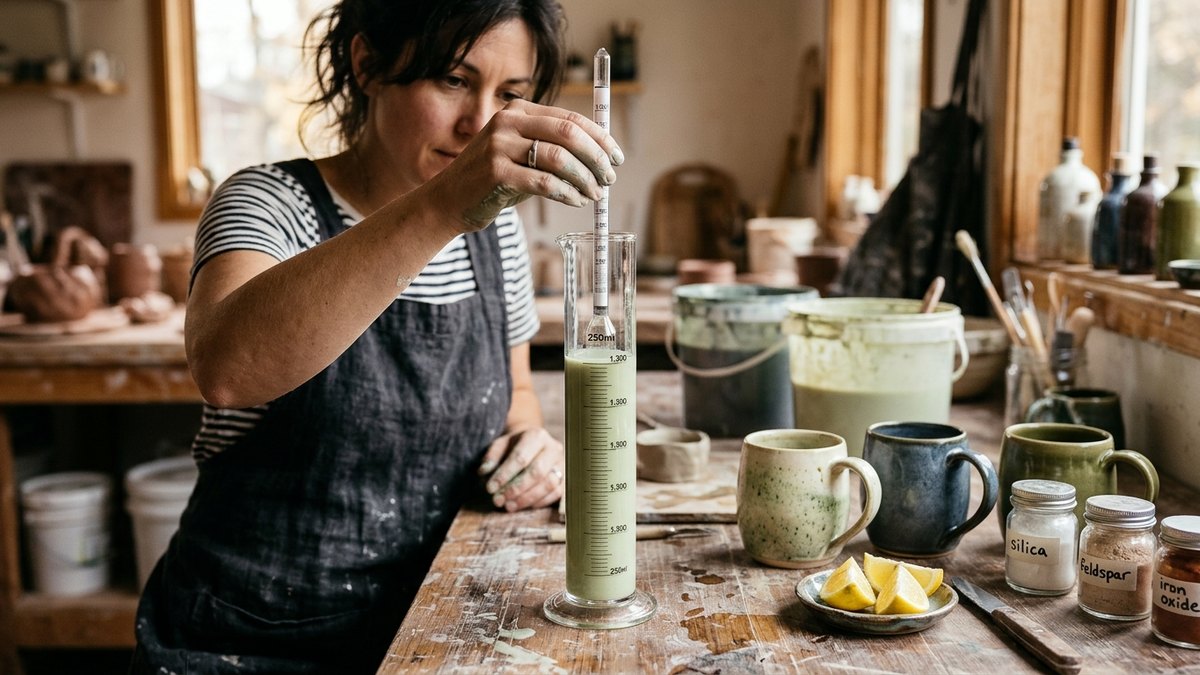
Ceramic Laboratory Practice: Slurry hydrometer calibration (1.45 to 1.50 SG target), acid leaching verification, and molecular oxide ratios.
What makes a pottery glaze food-safe and durable? A food-safe glaze requires two critical factors: chemical durability and mechanical stability. Chemically, it must have a balanced Unity Molecular Formula (UMF) with sufficient silica (SiO₂ > 3.0) and alumina (Al₂O₃ > 0.35) at Cone 6 to prevent metal leaching. Mechanically, the liquid slurry must be calibrated with a hydrometer to a Specific Gravity (SG) of 1.45 to 1.50 g/ml for dipping. Never use crazed glazes on food surfaces due to bacterial absorption in porous clay underbodies.
Scale Glaze Recipes & Calibrate Slurry Specific Gravity
Batch 100g test samples up to 10,000g production dipping buckets, calculate water addition by dry powder weight, and dial in precise hydrometer targets.
The Chemistry of Food-Safe Glazes: The Three-Part Oxide Balance
Potters frequently ask: "Is this glaze food-safe?" In studio ceramics, "food safety" is not a label printed on a commercial bottle—it is an empirical property of fired ceramic glass. A commercial glaze labeled food-safe can become toxic and leach heavy metals if it is under-fired, cooled improperly, applied too thick, or mixed with contaminated water.
Every ceramic glaze consists of three distinct chemical oxide groups arranged in a Unity Molecular Formula (UMF):
Silica (SiO₂)
Provides the physical backbone of the glass. Pure silica melts at 1710°C (3110°F), which exceeds studio kiln limits. Stable Cone 6 glazes require between 3.0 and 4.2 molecular equivalents of SiO₂.
Alumina (Al₂O₃)
Acts as the stiffener. Without alumina, molten glass turns into runny liquid that puddles on your kiln shelf. Alumina bonds silica into a durable, scratch-resistant, acid-resistant surface.
RO / R₂O Oxides
Alkaline and alkaline-earth metals (CaO, MgO, K₂O, Na₂O) that chemically lower silica's melting point to Cone 5/6 (1200°C–1222°C). In balanced UMF, the sum of fluxes equals exactly 1.0.
When silica and alumina are deficient, the fluxes cannot fully integrate into the crystalline matrix. If colorants like copper carbonate, cobalt oxide, manganese dioxide, or barium carbonate are present, acidic foods (like lemon juice, tomato sauce, or black coffee) break weak chemical bonds and leach toxic ions directly into food.
Specific Gravity (SG): Why Volume Cups Fail
Mixing dry glaze powder with water using measuring cups or judging thickness by how the slurry coats your thumb or a wooden stir stick is the number one cause of crawling, pinholes, and uneven glaze thickness in pottery studios.
Specific Gravity (SG) is the ratio of the weight of a liquid glaze slurry compared to the exact same volume of pure water (where 1.00 ml of pure water equals 1.00 gram at room temperature).
Two Verified Methods to Measure Glaze Specific Gravity:
Specific Gravity Targets by Application Method
Different studio application techniques require different moisture ratios. Using dipping-density glaze in an airbrush will clog the fluid nozzle immediately, while applying spray-density glaze on a bisque mug requires five dips and causes muddy runs.
| Application Method | Optimal SG Range | Weight of 100ml | Dip Time (Cone 04 Bisque) | Deflocculant / Binder |
|---|---|---|---|---|
| Studio Dipping & Pouring | 1.45 – 1.50 | 145g – 150g | 2.5 to 3.0 Seconds | Plain Water / Darvan #7 |
| HVLP Spray Booth | 1.35 – 1.40 | 135g – 140g | Continuous Mist | High water + fine mesh filter |
| Hake Brush Application | 1.55 – 1.62 | 155g – 162g | 3 Multi-Directional Coats | 1%–2% CMC Gum Binder |
| Crystalline / Flow Glazes | 1.60 – 1.68 | 160g – 168g | 1.5 Seconds (Thin Base) | Low clay content + catch basin |
Two In-Studio Safety Audits: Acid Leaching & The Crazing Hazard
1. The 24-Hour Lemon Juice & Vinegar Acid Test
To verify whether a glaze's molecular network resists culinary acid exposure, cut a fresh lemon wedge and place it directly against the fired interior of a finished mug or bowl. Cover with plastic wrap and let it sit undisturbed for 24 hours at room temperature.
Rinse thoroughly and inspect the surface under bright raking light:
• PASS: The surface maintains full gloss, with zero discoloration, cloudiness, texture change, or demarcation line where the lemon wedge sat.
• FAIL: Any dulling, color lightening, or metallic sheen indicates acid-leached glaze components. This glaze is unsuitable for functional foodware and must be rebalanced with additional silica or alumina.
2. The Crazing & Bacterial Infiltration Trap
Crazing is a fine network of microscopic cracks in the glaze layer caused by a thermal expansion mismatch: the glaze contracts more than the clay body during cooling, placing the glass under tensile failure.
Even if a glaze formula contains zero toxic metals, crazed glaze on functional dinnerware is a hygiene hazard. Liquids like soup, milk, and coffee seep through glaze fissures directly into the semi-porous ceramic body below. Commercial dishwashers cannot sanitize the damp underbody, creating colonies of mold and bacterial growth inside functional mugs.
Verified Ceramic Materials & Chemical Distributors
Sourcing raw glaze oxides (Whiting, Custer Feldspar, EPK, Silica 325 mesh) or pre-formulated commercial glazes from Amaco, Mayco, and Coyote? View verified USA suppliers with published SDS safety data.
Frequently Asked Questions (Pottery Glaze Chemistry & Safety)
What is the best specific gravity for dipping pottery glazes?
For Cone 5 and Cone 6 studio dipping glazes, an optimal Specific Gravity is between 1.45 and 1.50 g/ml. This range provides a smooth 1mm to 1.2mm dry coating on standard Cone 04 bisque ware in a 3-second dip.
Can a glaze be food-safe if it crazes?
No. Even if the chemical ingredients are non-toxic, crazing fractures the impermeable glass barrier, allowing food liquids and fats to soak into the porous bisque clay beneath, where bacteria and mold multiply.
How do I fix a glaze slurry that is too thick?
Do not simply dump water into the bucket. First check specific gravity with a hydrometer or 100ml syringe. If SG is high (>1.55), add water in 50ml increments. If SG is already normal (1.45) but the glaze acts thick like pudding, add 2–3 drops of Darvan #7 deflocculant to thin it.
What oxides should be avoided on the food contact surfaces of functional mugs?
Avoid high concentrations of toxic heavy metal oxides on interior surfaces: barium carbonate, lead, raw manganese dioxide, lithium carbonate, and high concentrations of copper oxide (>3%), which leach rapidly in acidic beverages.
How do I calculate water weight when mixing a 10,000g glaze batch?
A standard rule of thumb for dry glaze powders is to begin with 75% to 80% water by dry powder weight. For 10,000 grams of dry powder, add 7,500g (7.5 liters) of water, mix thoroughly, sieve through an 80-mesh screen, and adjust up to your target 1.48 SG.
What is the difference between food-safe and food-durable pottery glazes?
"Food-safe" means the glaze does not leach toxic heavy metals into food under laboratory conditions. "Food-durable" means the glaze also resists knife cutlery marking, acidic food etching, and dishwasher detergent degradation over years of daily kitchen use.