How to Convert 3D Print STL Volume to
Silicone Mold & Resin Weight
Published on October 9, 2026 • By MakerRatio Studio Team • Calibrated to Slicer Mesh Geometry & Material TDS
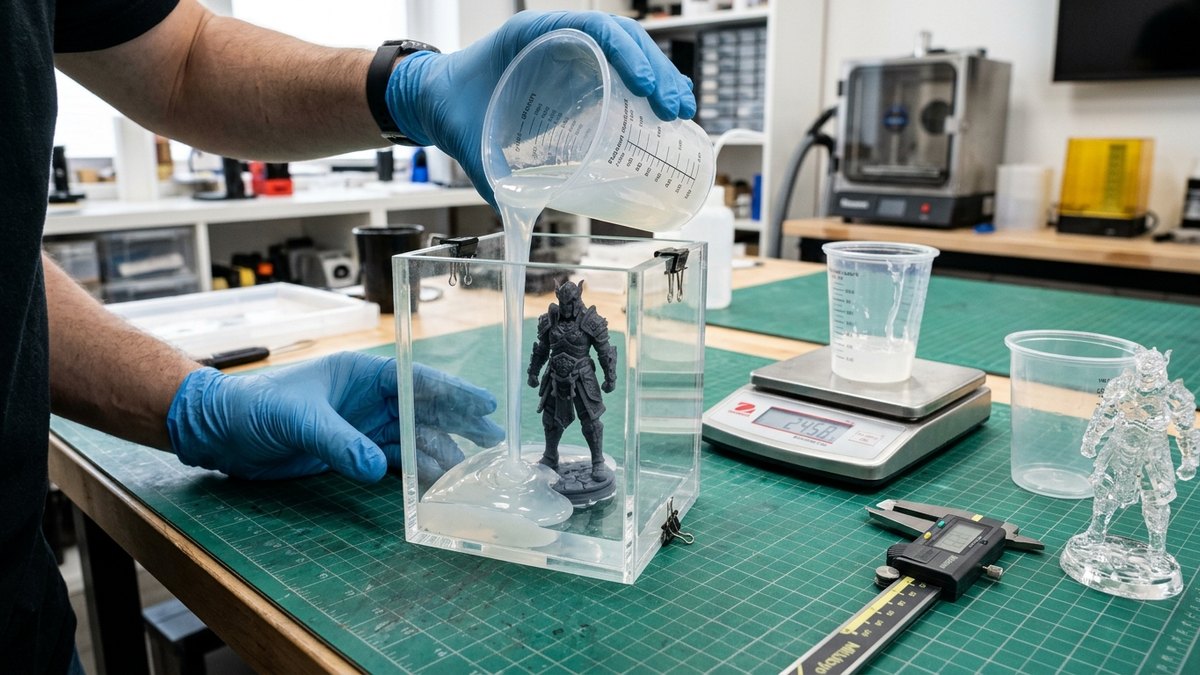
Engineering Workflow: Slicer mesh volume (cm³) subtraction from mold box bounding volume, scaled by material specific gravity.
How do you calculate silicone and resin weight from a 3D print STL? First, check your model's volume in cubic centimeters (cm³ or ml) inside your slicer. For silicone, subtract that STL volume from your total mold box volume: Silicone Volume = (Box L × W × H) - STL Volume, then multiply by the silicone's density (typically 1.15 to 1.25 g/ml). For casting resin, multiply the STL volume by the resin's specific gravity: Resin Weight (g) = STL Volume × 1.12. Always add 10% extra for mixing cup residue.
Upload STL or Enter Slicer Volume
Compute exact mold box clearance, silicone part A/B split, and casting resin weight automatically with our interactive tool.
3D printing a clean master model on a resin (SLA) or filament (FDM) printer is only the first step. When you want to replicate that piece by making a silicone block mold and casting copies in epoxy or polyurethane, the math gets tricky fast.
Slicers report object mass based on print filaments or photopolymer resins, displayed in grams or cubic centimeters (cm³). But liquid silicone rubber and casting resins have completely different densities, and building a mold box means filling the empty space around your print, not the print itself.
If you misjudge these numbers, you either under-pour silicone (leaving the top of your master poking out of a \$40 mold) or mix way too much resin that cures uselessly inside your mixing cup. Here is the practical, step-by-step way to turn your slicer's volume into exact grams for your mold box silicone and casting resin.
Step 1: Get the True Mesh Volume from Your Slicer
Before touching a scale or mixing cup, you must find the true enclosed geometric volume (V_STL) of your 3D model. Because 1.00 cm³ = 1.00 milliliter (ml), this gives you the exact liquid displacement of the master:
Resin Slicers (Chitubox / Lychee)
Slice your master at 100% solid infill (or check the model volume panel before hollowing). Look at the bottom status bar for Model Volume (ml). Note: do not include the volume of print supports unless you plan to cast the supports inside the mold.
FDM Slicers (PrusaSlicer / Bambu / Cura)
In PrusaSlicer or Bambu Studio, right-click the model and select Edit / Model Info to see raw mesh volume in cm³. In Cura, inspect the sliced model preview: multiply the total filament length by cross-sectional area, or slice at 100% infill with material density set to 1.0 g/cm³.
Step 2: The Mold Box Void Subtraction Formula
To pour a block mold around your 3D printed master, you build a containment box (often from acrylic sheets, foam board, or LEGO bricks). The silicone required is equal to the total internal volume of the box minus the physical displacement of the master:
Clearance Rule: Maintain a minimum clearance of 0.5 inches (12.5mm) between the outermost edge of your 3D print and the interior walls of the box. Insufficient clearance leads to mold wall tearing under demolding pressure. You can run automated box dimensions using our Mold Box Silicone Calculator, or verify irregular physical models with our Water Displacement Mold Volume Guide.
Step 3: Convert Volume (ml) to Weight (Grams)
Volume in milliliters cannot be poured on a digital scale without converting to weight in grams. Relying on simple 1ml = 1g volume assumptions is the #1 cause of sunken molds (read our forensic guide on Why Resin Molds Often Short-Pour: Specific Gravity Guide). Liquids vary significantly in density:
| Material System | Specific Gravity (g/ml) | Multiplier per 100ml STL | Recommended Ullage |
|---|---|---|---|
| Smooth-On Mold Star 15/30 (Platinum) | 1.18 g/ml | 118 g | +10% (Cup residue) |
| Smooth-On OOMOO 30 (Tin Cure) | 1.34 g/ml | 134 g | +8% (High viscosity) |
| Standard Polyurethane Resin (Smooth-Cast 300) | 1.05 g/ml | 105 g | +5% (Rapid pour) |
| Casting Epoxy Resin (2:1 Deep Pour) | 1.12 g/ml | 112 g | +5% (Low viscosity) |
| Jesmonite AC100 (Mineral Composite) | 1.75 g/ml | 175 g | +10% (Thick slurry) |
Critical Warning: 3D Resin Cure Inhibition on Platinum Silicone
One of the most frequent disasters in craft casting occurs when pouring platinum-cure silicone over a freshly printed SLA/DLP photopolymer resin master:
UV-photopolymer resin prints contain residual sulfur compounds, amine photoinitiators, and unreacted free radicals. When platinum silicone comes into direct contact with these chemicals, the platinum catalyst is permanently poisoned. The silicone touching the print never cures, remaining a sticky, toxic sludge that permanently ruins both your 3D print and your mold.
Recommended Materials for 3D Print Mold Making
Pair your mathematical estimates with verified industrial-grade mold rubbers and casting matrices:
Recommended Materials & Tools for this Project
Standard UV Photopolymer 3D Printing Resin (1kg)
Specification: Standard 405nm LCD/DLP photopolymer resin with 1.10 g/ml density for high-resolution miniatures and functional prototypes.
Precision Digital Gram Scale (0.01g Accuracy)
Specification: Tare-capable digital scale with 0.01g to 500g range for exact Part A and Part B chemical weight measurement.
Transparency Notice: As an Amazon Associate, MakerRatio earns from qualifying purchases at zero extra cost to you. Product recommendations are selected based on verified Manufacturer Technical Data Sheets (TDS). Always consult chemical safety data before pouring.
Related Workshop Guides & Precision Tools
Frequently Asked Questions About STL Volume & Mold Math
How do I convert STL cubic centimeters (cm³) to grams?
Multiply the cm³ volume by your casting material's specific gravity. For example, a 150 cm³ model cast in epoxy resin (density 1.12 g/ml) weighs exactly 168 grams (150 × 1.12).
Why did my platinum silicone stay sticky on my 3D resin print?
Unreacted sulfur, amines, and photoinitiators in UV photopolymer 3D resins poison the platinum catalyst, preventing polymerization. Coat the print in clear acrylic lacquer or use tin-cure silicone instead.
How much clearance should I leave around a 3D print in a mold box?
Maintain at least 0.5 inches (12.5mm) of wall and base clearance. Thinner silicone walls flex excessively during casting and tear rapidly along sharp parting lines.
Should I hollow my 3D print master before molding?
Solid masters are preferred for block molds because liquid silicone exerts buoyant force, causing lightweight hollow prints to float if adhesive tape or hot glue fails. If hollowed, seal drain holes completely.
How much silicone is lost to mixing cup ullage?
Between 5% and 10% of mixed silicone remains stuck to the container walls and stir stick due to high viscosity. Always mix 10% more silicone than your net void calculation.