How to Measure Irregular Mold Volume with Water:
The Gram-to-Resin Guide for Silicone Molds
Published on October 9, 2026 • By MakerRatio Studio Team • Grounded in Archimedes Fluid Physics & Density Standards
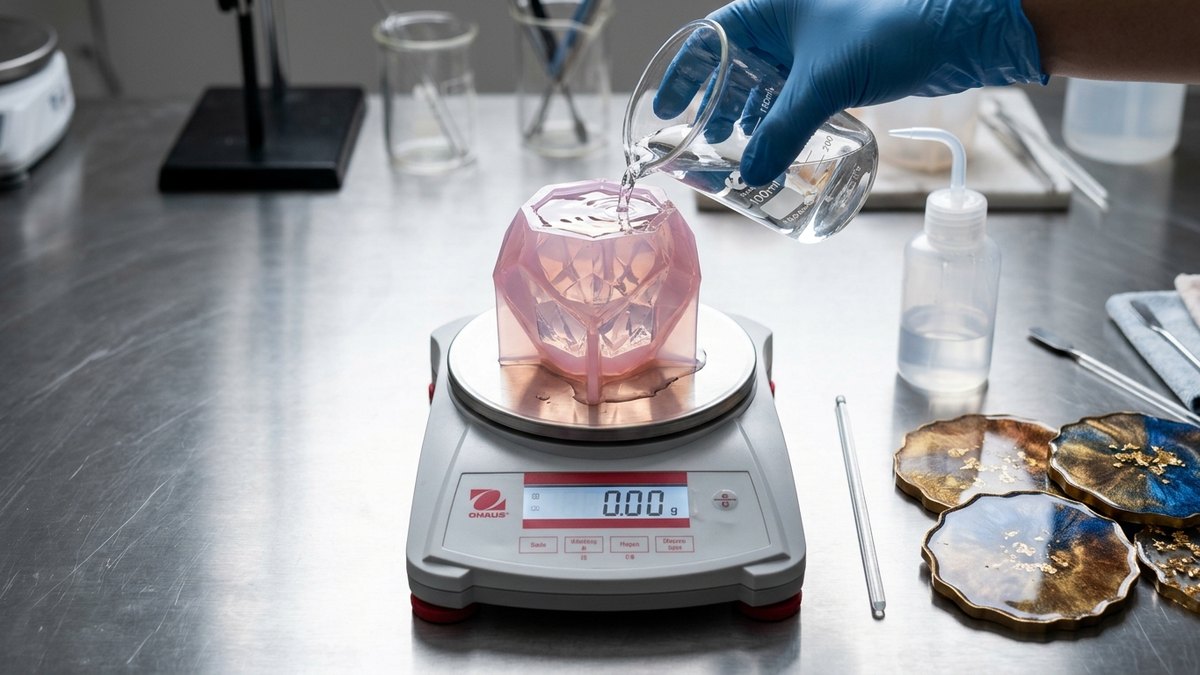
Archimedes Method: Measuring water mass (1.00g = 1.00ml) on a tared digital scale, then applying material specific gravity.
How do you calculate resin weight from water displacement? Place your dry silicone mold on a digital gram scale and tare it to zero. Fill the mold cavity with water level with the rim; the scale reading gives you the volume directly in milliliters because 1.00 gram of water = 1.00 ml. Empty and dry the mold completely. Then multiply that water weight by your casting material's specific gravity: multiply by 1.12 for epoxy resin, 1.75 for Jesmonite AC100, or 2.05 for craft concrete.
Instant Water-to-Resin Converter
Enter water displacement weight in grams to calculate exact Part A/B splits for epoxy, silicone, Jesmonite, and concrete.
Standard rectangle, circle, and cylinder formulas ($L \times W \times D$ or $\pi r^2 h$) work fine for basic trays and coaster blanks. But the moment you pour into a faceted crystal obelisk, an anatomical skull, a wavy trinket dish, or a textured creature mold, geometric math is practically impossible.
Most makers try one of two things: eyeball the cup or mix an arbitrary amount of resin and hope for the best.
Underestimating leads to an irreversible short-pour—leaving you with a half-filled cavity, ruined jagged edges, and wasted expensive resin. Overestimating leaves you with extra mixed resin hardening into a useless block in your cup. The cleanest and most foolproof solution is Archimedes' water displacement method on a digital gram scale.
Why 1 Gram of Water Equals 1 Milliliter (The Digital Scale Shortcut)
At room temperature (68°F to 72°F / 20°C to 22°C), pure distilled water has a physical density of exactly 0.998 g/cm³ (effectively 1.00 g/ml). This constant gives crafters an invaluable calibration shortcut:
You do not need a volumetric graduated cylinder. Your digital kitchen or gram scale reads volume directly in milliliters the instant water is weighed.
The 4-Step Water Measurement Method
Step 1: Level & Tare the Dry Silicone Mold
Ensure your digital gram scale is placed on a completely flat, level tabletop. Place your completely clean, dry silicone mold onto the center of the scale platform. Press the TARE (Zero) button. The scale must read 0.0g with the empty mold on it.
Step 2: Fill to the Flat Meniscus Level
Using a squeeze bottle or narrow pour beaker, gently fill the mold cavity with room-temperature tap water. Fill until the water surface forms a completely flat plane flush with the mold lip. Do not overfill to create a domed convex meniscus.
Record the Weight: If the scale reads 184.5g, the exact internal volume of that mold cavity is 184.5 ml.
Step 3: The Dehydration Protocol (Crucial Safety Gate)
Pour the water out. Never pour resin into a damp mold. Even microscopic water droplets trapped in silicone micro-pores will cause catastrophic chemical reactions:
- In Polyurethane Resin: Water reacts instantly with isocyanate molecules to create gaseous carbon dioxide (CO2), transforming the casting into brittle, frothy foam.
- In Epoxy Resin: Water halts amine cross-linking, causing localized cloudy white blooming, sticky surfaces, and surface delamination.
- How to Dry: Wipe thoroughly with a lint-free microfiber towel, then blow warm (not hot) air with a hair dryer or let sit for 30 minutes until 100% bone dry.
Step 4: Multiply by Material Density + Ullage
Because craft materials are denser than water, multiply your measured water weight by the material's specific gravity, plus 5% extra ullage for mixing cup residue (see why raw water estimation causes concave defects in our guide on Why Resin Molds Often Short-Pour). If you are designing master patterns digitally rather than physical masters, consult our guide on How to Convert STL Volume to Silicone Mold & Resin Weight:
Water-to-Material Conversion Multipliers
Use this empirical reference matrix to convert any water displacement reading (grams) into batch weights:
| Casting Material | Specific Gravity | Direct Multiplier (+5% Cup Loss) | For 100g Water Cavity |
|---|---|---|---|
| Tabletop & Art Epoxy Resin | 1.15 g/ml | × 1.20 | 120 grams total |
| Deep Pour Casting Epoxy (2:1 / 3:1) | 1.08 – 1.12 g/ml | × 1.16 | 116 grams total |
| Jesmonite AC100 (2.5:1 Base:Liquid) | 1.75 g/ml | × 1.84 | 184 grams total (131g base / 53g liq) |
| Craft Microcement / Concrete | 2.05 g/ml | × 2.15 | 215 grams total wet mix |
| Fast-Cast Polyurethane (1:1) | 1.05 g/ml | × 1.10 | 110 grams total (55g A / 55g B) |
| Soy / Paraffin Candle Wax | 0.86 – 0.90 g/ml | × 0.92 | 92 grams solid wax flakes |
Recommended Tools for Precision Displacement Sizing
Eliminate batch scale errors with calibrated digital gram balances and clean pour labware:
Recommended Materials & Tools for this Project
Graduated Silicone Resin Mixing Cups & Stir Sticks
Specification: Non-stick flexible silicone measuring beakers with pour spouts. Dried epoxy and silicone peel away with zero waste.
Precision Digital Gram Scale (0.01g Accuracy)
Specification: Tare-capable digital scale with 0.01g to 500g range for exact Part A and Part B chemical weight measurement.
Transparency Notice: As an Amazon Associate, MakerRatio earns from qualifying purchases at zero extra cost to you. Product recommendations are selected based on verified Manufacturer Technical Data Sheets (TDS). Always consult chemical safety data before pouring.
Related Workshop Guides & Precision Tools
Frequently Asked Questions About Water Displacement Math
Does 1 ml of water always equal 1 gram on a scale?
Yes. At room temperature, pure water has a density of 0.998 g/cm³, which rounds to exactly 1.00 g/ml for crafting and workshop purposes.
Why can't I pour resin into a mold measured with water immediately?
Moisture ruins curing chemistry. Water causes foaming carbon dioxide bubbles in polyurethane resins and cloudy soft patches in epoxy. The mold must be dried 100% bone dry.
How do I convert water weight to 2:1 epoxy resin?
Multiply water weight by 1.12 to get total resin weight. Then divide by 3: Part A is two-thirds of the total weight, and Part B is one-third.
What is the density multiplier for Jesmonite AC100?
Multiply water weight by 1.75 to get total Jesmonite mix weight. Then split into 2.5 parts base powder and 1 part acrylic liquid.
How much extra material should I mix for mold cup loss?
Add 5% to 10% extra material (ullage) to account for viscous resin or slurry that clings to the mixing cup walls and stir stick.