Raku Pottery Glazes & Firing Guide:
Recipes, Reduction Chambers & Studio Safety
Published on October 26, 2026 • By MakerRatio Studio Team • Calibrated to Western Raku Reduction Redox Chemistry
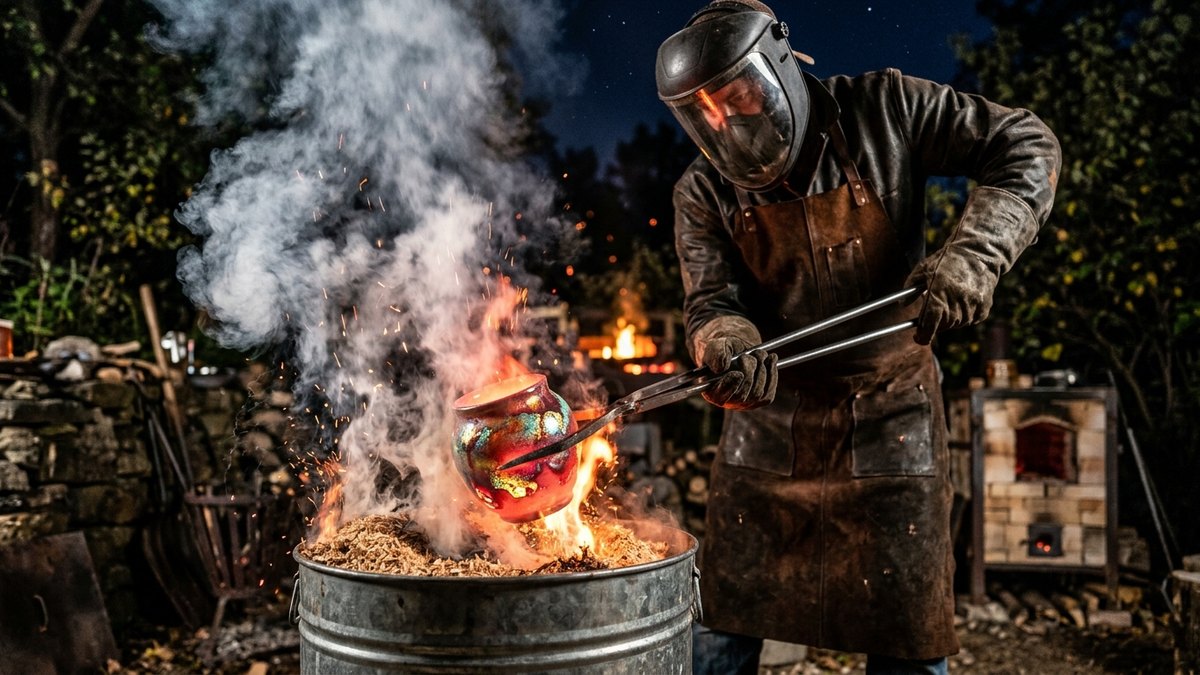
Studio Process: Red-heat extraction (1,800°F / Cone 06), combustible sawdust reduction, and thermal crackle cooling.
What is Raku firing and are Raku glazes food-safe? Western Raku is an extreme thermal shock process where bisqued pottery is heated rapidly to red heat (approx. 1,800°F / 982°C / Cone 06), pulled glowing-hot from the kiln with metal tongs, and immediately sealed into an airtight metal chamber filled with organic combustibles (sawdust, newspaper, or straw). The oxygen-starved smoke forces copper and iron oxides to reduce into brilliant metallic flashes (CuO + CO → Cu⁰ + CO₂↑) while unglazed clay turns matte carbon black. Raku is strictly decorative and NOT food-safe because the clay body remains porous and unvitrified.
Calculate Studio Kiln Electrical Firing & Energy Costs
Determine exact kilowatt-hour consumption, kiln element wear, and firing expenses across bisque, Cone 6, and low-fire Raku cycles.
The Physics of Western Raku: Thermal Shock & Clay Formulation
In standard ceramic production, temperature changes must be slow and gradual to prevent pieces from shattering due to the quartz inversion point at 573°C (1063°F). Western Raku violates every standard firing convention: pots are brought from room temperature to bright cherry-red heat (1800°F / 982°C) in under 60 minutes, plucked with steel tongs into room air, and submerged into combustible fuel.
Standard porcelain or smooth tight stoneware will shatter instantly under these conditions. To survive Raku firing, the clay body must be formulated with 15% to 25% coarse grog or kyanite.
Coarse grog particles act as microscopic mechanical shock absorbers. When thermal gradients cause the outer ceramic surface to contract rapidly while the interior remains red-hot, the resulting stress micro-fractures terminate against grog grains rather than propagating across the pot as catastrophic cracks.
Reduction Chamber Chemistry: How Oxygen Starvation Creates Copper Lustre
The dramatic metallic rainbow, copper sheen, and turquoise lusters characteristic of Raku do not come from the kiln—they are created inside the reduction barrel.
When glowing ceramic ware is placed into a galvanized metal container packed with pine sawdust or shredded newspaper, the combustible materials immediately ignite in flames. Dropping an airtight metal lid over the container starves the fire of atmospheric oxygen ($O_2$).
The Redox (Reduction-Oxidation) Reaction:
Deprived of ambient air, the burning carbon fuel scavenges oxygen directly from the metal oxides dissolved in the molten glaze:
If left in reduction for too long without sealing, or if exposed to ambient air while still above 300°C (572°F), the metallic copper re-oxidizes back into black copper oxide ($CuO$) or green copper carbonate.
Two Classic Studio Raku Glaze Recipes (Cone 06 Low-Fire)
Raku glazes rely on powerful low-temperature fluxes (primarily Gerstley Borate or Ferro Frit 3110) that liquefy into a runny glass matrix between 1750°F and 1850°F:
Copper Matte Raku Glaze
Yields vivid iridescent flashes of fuchsia, gold, teal, and pure copper. Requires immediate chamber sealing and rapid water quench at 400°F to freeze reduction.
White Crackle Raku Glaze
Creates a milky white porcelain appearance. In the reduction chamber, carbon smoke forces its way deep into thermal shock fissure cracks, creating jet-black spiderweb veins.
Studio Safety: Managing Extreme Heat, Toxic Vapors & Fuel
Western Raku is an inherently dangerous pyrotechnic process. Working with red-hot pots, open flames, and burning organic materials requires strict workshop safety protocols:
1. Personal Protective Equipment (PPE)
Never wear synthetic fleece, nylon, or polyester near a Raku kiln (synthetic fabrics melt into skin upon contact with embers). Wear 100% heavy cotton denim or leather welding jackets, Kevlar thermal gloves rated to 1000°F (537°C), a full-face polycarbonate grinding shield, and closed-toe leather work boots.
2. Respiratory Safety (Smoke & Metal Fumes)
Raku reduction produces dense carbon monoxide, wood smoke particulate, and vaporized metal fumes (copper and cobalt). Always conduct Raku firings outdoors in a well-ventilated open-air yard at least 15 feet away from wooden overhangs or combustible structures. Wear an OSHA-approved half-mask respirator equipped with P100 particulate and organic vapor cartridges.
Why Raku Ceramics Are Strictly Non-Functional (Never Food-Safe)
Every customer who buys a ceramic piece at a craft show or gallery expects to put tea or soup in it. As a professional maker, you must clearly inform customers that Raku pottery cannot be used for food, beverages, or holding standing water:
- Porous, Unvitrified Clay: Because Raku is fired to only Cone 06 (1800°F), the clay body remains porous with an absorption rate typically between 8% and 15%. Liquid seep through the vessel walls onto wooden tables.
- Heavy Metal Leaching: Copper matte and luster recipes contain high percentages of unfritted copper oxide that lack sufficient silica and alumina glass networks, leaching toxic ions immediately into acidic foods.
- Bacteria Harbors in Fissures: The carbon-filled crackle lines are open mechanical fractures that cannot be sanitized in a dishwasher or by hand washing.
Raku Tongs, Frits & High-Grogg Clay Sourcing
Looking for heavy 41-inch stainless steel Raku tongs, specialty Ferro Frits (3110, 3134), or high-grogg commercial Raku clays from Laguna or Standard? View verified USA distributors with studio freight shipping.
Frequently Asked Questions (Raku Glazes & Firing)
Can Raku pottery hold water for flowers?
No. Raku pottery is low-fired (Cone 06) and the clay body remains porous, allowing water to weep slowly through the walls and base. To use a Raku vase for fresh flowers, insert a glass or plastic water cylinder inside the piece.
How do you keep copper matte Raku glaze from turning brown or black?
Copper matte glazes turn brown if exposed to ambient oxygen while cooling between 500°F and 300°F. Keep the reduction chamber sealed tightly until the pot drops below 300°F, or quench the piece in a clean water bucket immediately after a 2-minute reduction to freeze the metallic luster.
What kind of sawdust is best for Raku reduction?
Fine, dry pine or softwood sawdust from a woodshop or lumber mill works best. Avoid pressure-treated lumber (which contains toxic arsenic and chromium compounds) and wet sawdust, which cools the pot too quickly without igniting rich carbon flames.
Can you do Raku firing in a standard electric kiln?
Yes, but you must shut off the electric kiln breaker before opening the lid to pull glowing pieces with metal tongs to prevent electric shock from exposed heating elements. Furthermore, never put combustibles inside the electric kiln—carry pieces to an outdoor metal can.
Why do my Raku pots crack during extraction?
Cracking occurs from thermal shock if the clay body lacks sufficient coarse grog, if wall thickness is uneven, or if the potter grips the hot rim too tightly with cold metal tongs. Warm tong tips in the kiln before grabbing ware.
How do you clean and preserve finished Raku pottery?
After removing from the reduction chamber and cooling, scrub away soot and carbon with a soft nylon brush and warm soapy water. Once completely dry, coat copper matte surfaces with a thin layer of paste wax or acrylic sealant to prevent ambient air from slowly tarnishing the colors over time.