Why Candle Tops Sink, Crack & Frost:
The 464 Soy Wax Thermal Guide
Published on August 26, 2026 • By MakerRatio Candle Lab • Tested on 100+ Golden Wax 464 Batches
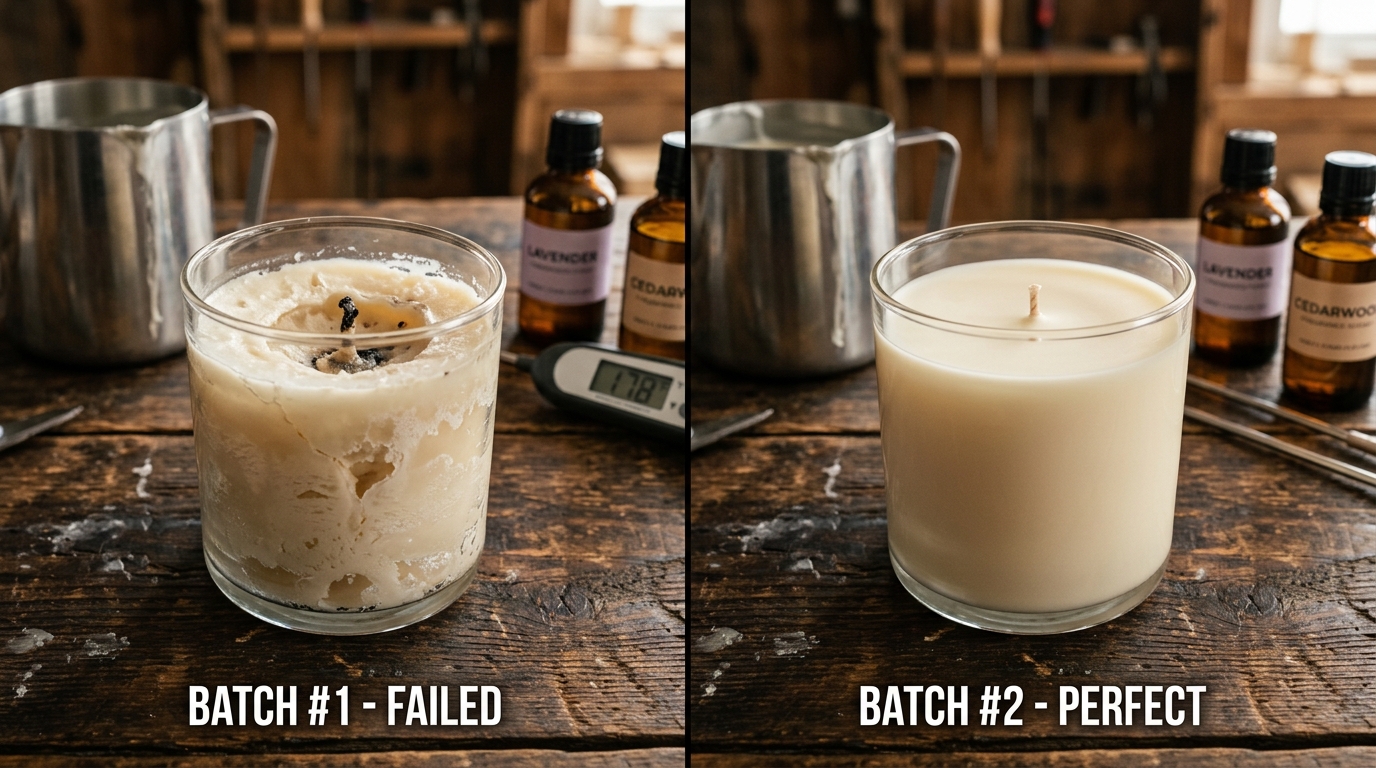
Studio Comparison: Batch #1 poured too hot (165°F) with sinkhole crater vs Batch #2 poured at 135°F with velvet smooth top.
Why do soy candle tops sink or crack around the wick? Soy wax (such as Golden Brands 464) shrinks by approximately 7% by volume as it transitions from liquid to solid. When hot wax is poured into cold glass jars, the outer edges cool and freeze first, pulling liquid wax away from the center and creating a sunken vacuum crater around the wick. To guarantee velvet-smooth tops every single pour, follow the Golden Temperature Rule: Melt to 185°F (85°C), add fragrance oil at 180°F (82°C), stir for 2 minutes, pre-warm your glass jars to 100°F (38°C), and pour at exactly 135°F ± 5°F (57°C) in a draft-free room.
Calculate Exact Wax & Fragrance Grams
Never guess container capacity or over-fill jars. Input jar fluid ounces, select wax type, and choose 6% to 10% scent load for exact flake weights.
Every chandler has opened their curing room in the morning, ready to inspect a fresh 24-candle batch of soy candles, only to discover deep, volcanic craters around every single wick.
The surfaces look rough, chalky white crystals ("frosting") crawl up the sides of the glass jars, and you face the tedious prospect of spending two hours wielding a heat gun to salvage your inventory.
Natural vegetable waxes—specifically hydrogenated soybean oil (GW 464, NatureWax C3, Soy 444)—are living crystalline structures. Unlike paraffin wax, which contains synthetic microcrystalline petrolatum plasticizers, soy wax crystal growth is governed entirely by thermal cooling gradients. Master the temperature milestones, and your candle tops will cure mirror-flat and creamy every time.
Diagnosing the 3 Classic Soy Wax Surface Defects
| Surface Defect | Visual Appearance | Root Thermal Cause | Permanent Fix |
|---|---|---|---|
| 1. Sinkhole Crater | Deep circular cavern directly surrounding the wick; hollow void below the surface. | Poured too hot (>150°F / 65°C) into cold jars. Rapid perimeter cooling traps hot liquid center. | Pour at 135°F + Pre-warm jars to 100°F |
| 2. Soy Frosting (Polymorphism) | White, cauliflower-like crystalline growth or snowflake film across the top and sides. | Triglyceride crystals forming unstable polymorphic beta-prime structures during rapid temp drops. | Slow ambient cooling (72°F) on wire rack |
| 3. Wet Spots / Glass Delamination | Clear patches on jar sides looking like liquid water trapped between wax and glass. | Wax pulled away from glass during shrinkage; air gap creates optical prism effect. | Clean jars with 91% IPA + warm jars before pouring |
The Golden 464 Temperature Trio (Exact Degrees & Timing)
Golden Brands 464 contains natural soy-based monoglycerides designed to lower melt points. To achieve maximum scent throw and velvet-smooth tops, adhere strictly to these 3 temperature gates:
Completely melts all crystalline memory seed crystals. If you only heat to 150°F, existing crystal seeds cause rough, bumpy tops during cooling.
Add fragrance oil at peak heat. Stir slowly for a full 2 minutes (120 seconds). The heat lowers wax surface tension, allowing oil molecules to bind fully with triglyceride chains.
Let the pitcher cool undisturbed until it reaches a cloudy "slushy" consistency. Pouring cool prevents center vacuum shrinkage and stops jar thermal shock.
Workshop Curing Environment: Why Granite & Metal Tables Ruin Candles
You followed the exact temperature gates, yet the bottoms of your candles contracted violently. Why?
The Conductive Heat Sink Trap: Setting hot glass candle jars directly onto cold granite, metal, or stainless steel workbenches acts as an aggressive heat sink. The bottom 1 inch freezes in 10 minutes while the top remains liquid, creating massive internal tension stress fractures.
- Elevate on Wire Cooling Racks: Always cure freshly poured candles on baker's wire cooling racks. Airflow underneath the glass ensures equal cooling from top, sides, and bottom.
- Space Jars 4 Inches Apart: If jars touch each other, the radiant heat between them slows down the facing sides, creating uneven lopsided tops.
- Maintain 70°F – 74°F Room Temperature: Never cure candles near air conditioning vents, open windows, or ceiling fans. Drafts cause rapid polymorphic frosting.
How to Fix Existing Sinkholes (The 10-Second Heat Gun Method)
If you already have a batch with sunken centers, you don't need to melt the whole candle down. Follow this rapid studio repair protocol:
- Take a Dual-Temperature Craft Heat Gun on its Low setting (never use an open torch on soy wax).
- Hold the nozzle 4 to 5 inches above the candle top.
- Move in a slow, circular motion around the outer perimeter first, working inward toward the wick.
- Melt the top 1/8 inch (3mm) of wax until a smooth liquid pool forms and fills the crater cavity.
- Keep the heat gun moving continuously to avoid scorching the cotton wick or overheating the glass rim.
- Let the candle cool undisturbed on a level table for 60 minutes. The surface will solidify into a satin mirror finish.
Verified Workshop Materials for Candle Making
Consistent, velvet-smooth candle tops require all-natural, unadulterated soy wax flakes and thermal-shock resistant glass vessels:
Recommended Materials & Tools for this Project
Golden Brands 464 All-Natural Soy Wax
Specification: 100% natural soy wax with soy additives. Melt point 115°F–120°F (46°C–49°C), designed for maximum 6%–10% fragrance retention.
8 oz Clear Glass Candle Mason Jars (12-Pack)
Specification: Annealed thermal-resistant glass jars with gold/black lids designed specifically for hot wax candle pouring.
Transparency Notice: As an Amazon Associate, MakerRatio earns from qualifying purchases at zero extra cost to you. Product recommendations are selected based on verified Manufacturer Technical Data Sheets (TDS). Always consult chemical safety data before pouring.
Frequently Asked Questions About Soy Candle Tops & Sinkholes
Does soy frosting affect the candle's scent throw or burn quality?
No. Frosting (white crystal formation) is purely a cosmetic characteristic of 100% pure natural soy wax. It does not affect burn performance, melt pool diameter, or fragrance scent throw in any way. In fact, many artisan chandlers educate their customers that frosting is definitive visual proof that the candle is made from pure, additive-free soy wax rather than petroleum paraffin.
Why should I pre-warm my glass candle jars before pouring?
Cold room-temperature glass creates immediate thermal shock when 135°F wax touches the walls. The wax freezes instantly against the glass while the center remains molten, causing wet spots and sinkhole craters. Warming your jars to approximately 100°F (38°C) using a heat gun or low oven ensures even, simultaneous cooling across the entire candle.
Can I do a "second pour" top coat instead of using a heat gun?
Yes. If your sinkhole is deeper than 1/4 inch, save 10% of your melted wax batch in your pitcher. Once the candle solidifies, re-heat the leftover wax to 140°F and pour a thin 1/8" "repour" layer over the top to level the crater perfectly.
How long should soy candles cure before test burning?
For Golden Wax 464, the minimum cure time is 7 to 14 days. Soy wax is composed of complex triglycerides that take two weeks to finish crystallizing and locking in fragrance molecules. Burning a soy candle 24 hours after pouring will result in weak scent throw and rapid tunneling.
Calculate Your Exact Batch Weights
Master your fragrance loads and container fills with MakerRatio's validated candle calculators.